
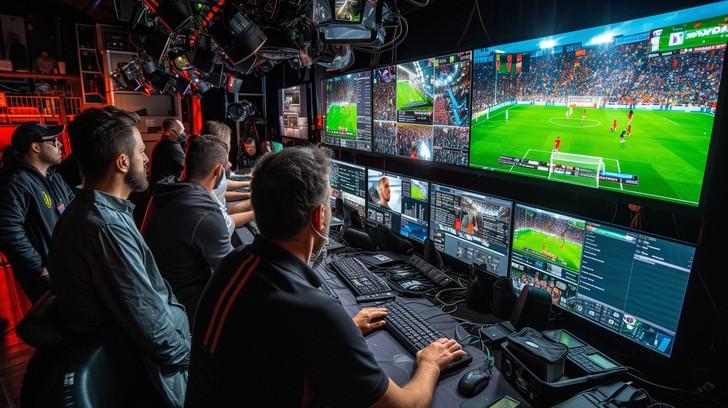
The Sports Broadcasting Technology Market Analysis approach in the Sports Broadcasting Technology Market increasingly starts with measurable service outcomes, not hardware feature lists. Decision-makers assess whether a technology stack can deliver consistent live experiences under peak loads, across diverse devices, and under strict rights rules. Latency is often the first benchmark because it directly affects fan engagement, social interaction, and in-play betting integrity. But analysis extends beyond “glass-to-glass delay” into stability and predictability: how often latency drifts, how quickly the system recovers after network impairment, and whether alternate feeds remain synchronized. Quality assessment also includes production integrity—frame accuracy in replay, consistent color and HDR handling, clean audio mixes, and reliable captioning. Rights complexity adds operational risk: territory-based entitlements, blackout zones, clip-length limits, language restrictions, and platform-specific sublicensing rules must be enforced automatically, especially when highlights are pushed rapidly to social channels. Market analysis therefore prioritizes end-to-end workflow visibility, automation maturity, and the ability to prove compliance through logs and reporting. Technology is judged on whether it reduces failure probability on the biggest days of the season while also lowering the cost of producing the long tail of events that drive audience growth.
Operational metrics have become the backbone of purchasing and renewal decisions. On the production side, teams measure ingest stability, packet loss, jitter tolerance, audio continuity, and timecode accuracy. They also measure operator efficiency: time to set up a show, time to publish first highlights, and the number of manual steps required to generate variants. On the distribution side, QoE metrics dominate: startup time, rebuffer ratio, average bitrate, bitrate switching frequency, video freeze events, audio sync issues, and error rates by device type. These metrics are increasingly correlated with business outcomes such as churn, session length, and ad completion rates. Mature organizations combine QoE analytics with audience engagement signals to determine which features merit investment—multi-angle feeds, alternate commentary, or interactive overlays. Another growing area is observability across the full chain: contribution, production processing, encoding, packaging, CDN, and player telemetry. Without that correlation, teams may over-invest in encoders when the real constraint is CDN routing or device player performance. Market analysis now favors vendors that provide actionable, unified monitoring and can support incident response playbooks during live events with clear escalation paths.
Risk analysis in sports broadcasting is uniquely unforgiving because failures happen in public, in real time, and at maximum audience scale. Rights holders evaluate redundancy patterns: dual contribution paths, multi-region cloud failover, encoder N+1 design, and multi-CDN routing with fast switching. They also assess security threats that can disrupt revenue, including credential abuse, stream restreaming, piracy, and compromised control planes. Watermarking, DRM, anti-piracy monitoring, and rapid takedown workflows are increasingly standard line items, not optional add-ons. Rights policy risk is equally significant; misapplied geo-rules or blackout logic can trigger contractual penalties and reputational damage. Cost risk has also intensified with cloud adoption. Egress charges, unbounded autoscaling, and duplicated storage can inflate budgets unless guardrails exist. Skills risk matters too: IP networking, cloud operations, automation, and security require training and new operating models. Strong market analysis weighs not only technical capability but also organizational readiness—whether a team can reliably run the system during a tournament cadence with minimal downtime and predictable change control.
Forecasting and investment prioritization increasingly hinge on total cost of ownership and scalability across seasons. Buyers compare capex-heavy on-prem models with cloud and managed-service approaches, factoring staffing, travel, maintenance, and lifecycle refresh cycles. They also model event calendars: bursty schedules favor elastic capacity, while year-round channels may justify more fixed infrastructure. A practical analysis framework tests representative event types—regular season, rivalry matches, playoffs—then validates how workflows scale across language variants, regional rights packages, and platform outputs. Many organizations now require proof-of-performance pilots that measure real latency, QoE, and operational burden under load. Future-looking analysis also evaluates readiness for codec transitions, HDR expansion, low-latency streaming evolution, and deeper data integrations for AR and personalization. In the Sports Broadcasting Technology Market, the strongest analysis is end-to-end and outcome-driven: it connects engineering metrics to fan experience and commercial performance, ensuring technology upgrades translate into reliability, engagement, and sustainable operating economics.
Top Trending Reports:
Open Source Intelligence Market

 English
 Arabic
 French
 Spanish
 Portuguese
 Deutsch
 Turkish
 Dutch
Dutch
 Italiano
 Russian
 Romaian
 Portuguese (Brazil)